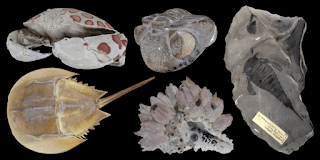
Arthropoda are bilaterally symmetrical, joint-legged invertebrates with chitinous exoskeletons—including crustaceans, chelicerates, hexapods, and myriapods—highlighted in the fossil record by trilobites such as Redlichia, Ogygiocaris, and Scutellum, which serve as key Paleozoic index fossils.
Related Articles

THE REPETITION THEORY
Crystallography is fundamentally based on periodic atomic repetition governed by symmetry elements—translation, rotation, reflection, inversion, and their combinations—which determine crystal structures and their 1D, 2D, and 3D patterns.
Read More

CRYSTALLOGRAPHIC SYMMETRY ELEMENTS
Crystallographic symmetry elements—zones and zone axes, center of symmetry (i), mirror planes (m), and rotation axes (n)—describe the geometric regularity of crystals and are fundamental for classifying crystal systems.
Read More

CRYSTALLOGRAPHIC PROJECTION
Crystallographic projection converts a crystal’s 3D form into 2D representations—through spherical, gnomonic, orthographic, and especially stereographic projections—to analyze crystal face orientation and symmetry.
Read More